
Beyond the Mind
We have explored how the mind “narrates” our life, how our subconscious detects patterns, and how our conscious “bandwidth” limits our ability to manage reality. Now, we must ground this architecture in the physical.
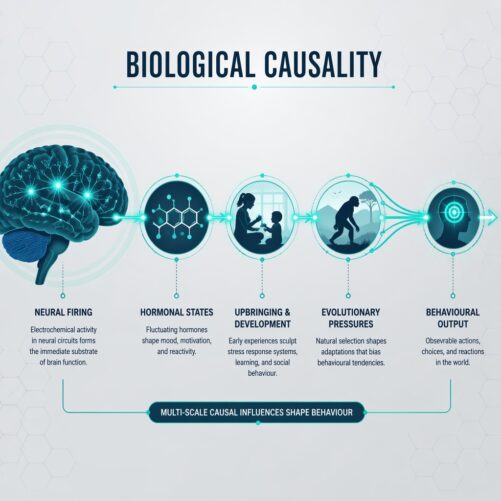
Robert Sapolsky, in his seminal work Behave, argues that human behaviour cannot be explained by a single cause. It is the result of layered influences, spanning from the millisecond a neuron fires to the evolutionary pressures of our ancestors millions of years ago.
The Core Science: Multi-Scale Causality
We often fall into the trap of “single-cause reductionism” – blaming a behavior solely on a personality trait, a bad childhood, or a hormone. Sapolsky demonstrates that behavior is actually a product of multi-scale causality.
To understand why someone acted in a specific way, you must zoom out across different time horizons:
The Timeline of Influence
- The “One Second Before”: What was happening in the brain at the exact moment of the action? (The firing of the amygdala, the prefrontal cortex engagement).
- The “Hours to Days Before”: What hormonal or environmental factors were influencing the brain’s sensitivity to that trigger?
- The “Years Before”: What was the individual’s upbringing, and how did it shape their neural pathways?
- The “Millennia Before”: How did evolutionary pressures shape the species to react in this way?
- Environment Design: Changing your input changes your biology.
- Repetition: The more you repeat an action, the more “efficient” the neural pathway becomes, making it your new default.
- Reflective Awareness: By understanding your biology, you can pause the “automatic” reaction and force the brain to recruit the prefrontal cortex – the seat of higher-level decision-making.
- Identify the “Trigger” Window: Recognize that your reactions to stress are biological (like the amygdala “low road” we discussed earlier). When you feel that surge, acknowledge it as biological “noise” rather than a true reflection of reality.
- Curate Your Inputs: If your biology is a product of your environment, curate the environments you expose yourself to. The media you consume, the people you surround yourself with, and the habits you practice are “programming” the biology that will drive your decisions tomorrow.
- Practice Empathy as a Discipline: Since your brain is wired for “We vs. They,” you must actively practice seeing the “out-group” as humans. This requires effort—m – the energy-expensive “System 2” thinking – but it is the only way to override the automatic biological bias.
Return to Hub: The Architecture of Human Behaviour