
A Scientific Framework for Understanding the Mind
The Myth of the Conscious Driver
For centuries, we have viewed the human mind as a “conscious captain” steering the ship of our behavior.
We believe that we carefully deliberate, analyze, and choose our actions.
Modern cognitive science, however, reveals a different reality: We are not the captains; we are the passengers.
Our conscious mind is a limited “user interface” – a dashboard displaying a small fraction of the complex, automatic processing happening in the subconscious “operating system” below.
To master your behavior, you must stop trying to “think” your way to change and start designing the environment and patterns that your subconscious operates within.
The Three Pillars of Human Behavior
Our research breaks down human cognitive function into three distinct, interconnected domains.
By understanding these, you move from “willpower-based” self-improvement to “architecture-based” optimization.
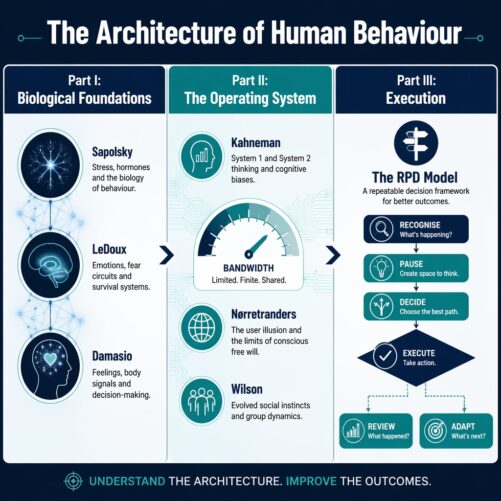
Part I: The Biological Foundations (The Hardware)
The physical constraints and evolutionary mechanisms that dictate behaviour.
- The Biological Architecture of Human Behaviour
- Understanding multi-scale causality: why behaviour is a chain reaction of biological inputs.
- Neural Pathways of Survival (LeDoux)
- Mapping the “Low Road” vs. “High Road”: how the brain processes threat and emotional response.
- The Biological Necessity of Feeling (Damasio)
- The Somatic Marker Hypothesis: why emotion is essential for rational decision-making.
Part II: The Operating System (The Interface)
The cognitive architecture that filters reality and generates the conscious narrative.
- The Bandwidth of Consciousness
- The “User Illusion”: why consciousness is a limited dashboard, not the central engine.
- The Dual-Process Mind
- System 1 (Intuitive) vs. System 2 (Logical): how the brain conserves energy and where biases originate.
- The Illusion of Introspection
- The Adaptive Unconscious: why the conscious mind is often a post-hoc narrator rather than the driver of action.
Part III: The Execution (Application)
Practical models for decision-making and pattern recognition.
- The RPD Model: Expertise Through Pattern Recognition
- Gary Klein’s model for effective decision-making under pressure.
What Is the Architecture of Human Behaviour and Why Does It Matter for Change?
A scientific framework for understanding why we think, feel, and act the way we do — built on seven foundational works in cognitive science, neuroscience, and behavioural psychology.
Why Is the Idea That We Consciously Control Our Behaviour a Myth?
The idea that we consciously control our behaviour is a myth because modern cognitive science has established that the conscious mind processes only a tiny fraction of the information the brain handles — functioning as a limited user interface rather than the central operating system it appears to be.
For centuries the dominant model of human behaviour placed the conscious mind at the centre — deliberating, choosing, directing. We experienced ourselves as the authors of our actions and concluded that we must therefore be their cause. This is what cognitive scientists call the illusion of conscious will.
The reality the research reveals is more humbling and more useful. The conscious mind processes roughly 40 bits of information per second. The subconscious system it sits atop processes an estimated 11 million bits per second. The behaviour we experience as chosen is generated almost entirely by automatic processes that completed their work before consciousness was even informed of the outcome.
Conscious will is the mind’s way of taking credit for things it was merely informed about. The experience of intending an action is real, but it follows rather than precedes the neural processes that initiate it.
Wegner, Daniel M., The Illusion of Conscious Will, MIT Press, .
To master behaviour you must stop trying to think your way to change and start designing the environment and patterns that your subconscious operates within. That is the central insight this knowledge system is built to deliver.
What Are the Three Domains That Together Constitute the Architecture of Human Behaviour?
The architecture of human behaviour consists of three interconnected domains — the biological foundations that set the hardware constraints, the cognitive operating system that filters and interprets reality, and the practical execution models that translate understanding into effective action.
Each domain is necessary. Understanding the biological foundations without the cognitive layer leaves you with neuroscience but no model of experience. Understanding the cognitive layer without the biological foundations leaves you with psychology ungrounded in physical reality. Understanding both without execution models leaves you with insight but no change. The seven spokes of this knowledge system cover all three domains in sequence — from hardware through interface to application.
What Does the Biological Foundation of Behaviour Consist Of?
The biological foundation of behaviour consists of the physical mechanisms — neural architecture, evolutionary survival systems, and the somatic basis of emotion — that set the constraints within which all human thought and action occur.
Behaviour does not begin with thought. It begins with biology. The structure of the nervous system, the speed of neural transmission, the evolutionary age of different brain regions, and the chemical environment of the body all shape what the mind can do and how it responds to experience. Understanding these foundations explains why behaviour so often resists conscious intervention — it is operating on biological imperatives older than language, culture, or deliberate reasoning.
Three spokes cover this domain in depth, drawing on the foundational work of Joseph LeDoux on neural threat processing and Antonio Damasio on the biological role of emotion in rational decision-making.
What Is the Cognitive Operating System and How Does It Generate the Experience of Consciousness?
The cognitive operating system is the layer of automatic processing — attention filters, dual-process cognition, and the adaptive unconscious — that constructs the conscious experience of reality from a curated fraction of available sensory and emotional data.
What we experience as reality is not reality. It is a model of reality constructed by the brain from incomplete information, filtered through prior experience, emotional state, and survival priorities. The conscious narrative we experience as our inner life is generated after the fact — a story the mind tells about decisions and reactions that were already underway.
Three spokes cover this domain, drawing on the bandwidth research of Tor Nørretranders, the dual-process theory of Daniel Kahneman, and the adaptive unconscious research of Timothy Wilson.
How Do You Apply an Understanding of Human Behaviour Architecture to Real Decision-Making?
You apply an understanding of human behaviour architecture to real decision-making by replacing the willpower model — trying to consciously override automatic responses — with the pattern recognition model, which trains the subconscious system to generate expert intuitions that produce reliable outcomes under pressure without deliberate analysis.
Gary Klein’s Recognition-Primed Decision model, drawn from research into expert decision-making in high-stakes environments including firefighting, military command, and intensive care medicine, demonstrated that effective real-world decisions are rarely the product of conscious deliberation. They are the product of trained pattern recognition — a subconscious system that has been shaped by experience to recognize situations and generate responses that work.
The final spoke in this system covers the RPD model and its implications for anyone seeking to build genuine expertise and reliable judgement rather than simply accumulating information.
What Are the Seven Knowledge Areas This System Covers?
This knowledge hub is the centre of a seven-spoke system — each spoke covering one essential dimension of human behaviour architecture, drawn from a foundational work in cognitive science or neuroscience, and sequenced from biological foundations through cognitive mechanisms to practical application.
- The Biological Architecture of Human Behaviour — understanding multi-scale causality and why behaviour is a chain reaction of biological inputs.
- Neural Pathways of Survival — mapping the Low Road and High Road of threat processing and emotional response, drawn from the work of Joseph LeDoux.
- The Biological Necessity of Feeling — the Somatic Marker Hypothesis and why emotion is essential for rational decision-making, drawn from the work of Antonio Damasio.
- The Bandwidth of Consciousness — why consciousness is a limited dashboard rather than the central engine, drawn from the work of Tor Nørretranders.
- The Dual-Process Mind — System 1 and System 2 thinking, how the brain conserves energy, and where cognitive biases originate, drawn from the work of Daniel Kahneman.
- The Illusion of Introspection — the adaptive unconscious and why the conscious mind is a post-hoc narrator rather than the driver of action, drawn from the work of Timothy Wilson.
- The RPD Model: Expertise Through Pattern Recognition — Gary Klein’s model for effective decision-making under pressure through trained pattern recognition.
What Are the Most Important Things to Understand Before Going Further?
- The conscious mind is not the driver of behaviour — it is a limited interface that experiences and narrates the outputs of subconscious processing it did not initiate and cannot fully observe.
- The subconscious processes 11 million bits of information per second compared to the conscious mind’s 40 bits — meaning the automatic system dominates human behaviour by an overwhelming margin.
- Benjamin Libet’s experiments demonstrated that neural activity initiating voluntary movement begins up to 550 milliseconds before conscious intention is reported — establishing that conscious awareness follows rather than precedes action.
- Daniel Kahneman’s research established that System 1 — fast, automatic, subconscious — dominates human decision-making, with System 2 — slow, deliberate, conscious — deployed rarely and effortfully.
- Effective behaviour change requires architecture, not willpower — designing the environments, patterns, and conditions the subconscious system operates within rather than relying on conscious effort to override it in the moment.
What Does This Page Not Cover?
This hub page establishes the overall framework and the three domains of human behaviour architecture. It does not cover the specific mechanisms of any individual domain in depth — each of the seven spoke pages covers one dimension in full detail, drawing on its designated foundational work. Work through the spokes in order for a complete and progressive understanding of the full framework.
How Was This Knowledge System Built?
This knowledge system was built on seven foundational works in cognitive science, neuroscience, and behavioural psychology — each chosen as the primary authority on one dimension of human behaviour architecture. Every content claim across all eight pages is traceable to one of those foundational sources. Nothing is invented or speculated beyond what the research supports.
Frequently Asked Questions About the Architecture of Human Behaviour
What is the architecture of human behaviour?
The architecture of human behaviour is the complete system of biological, cognitive, and psychological mechanisms that produce human thought, emotion, and action — most of which operate below the threshold of conscious awareness. Modern cognitive science has established that the conscious mind processes roughly 40 bits of information per second while the subconscious processes an estimated 11 million bits per second, meaning the vast majority of human behaviour is generated by automatic processes the conscious mind does not control and often cannot observe. Understanding this architecture shifts the basis of self-improvement from willpower — trying to consciously override automatic processes — to environment and pattern design, which works with the subconscious system rather than against it.
Why does understanding the subconscious mind matter for behaviour change?
Understanding the subconscious mind matters for behaviour change because the subconscious system generates the automatic responses, emotional reactions, habitual patterns, and decision-making shortcuts that constitute the majority of human behaviour — and none of these can be reliably changed by conscious effort alone. Nobel laureate Daniel Kahneman’s research established that System 1 thinking — fast, automatic, subconscious — dominates human decision-making while System 2 thinking — slow, deliberate, conscious — is effortful and rarely deployed. Effective behaviour change therefore requires designing the conditions, environments, and patterns that the subconscious system operates within, rather than relying on conscious deliberation to override it in the moment.
What is the difference between conscious and subconscious processing?
Conscious processing is the deliberate, sequential, effortful analysis of information that produces the experience of thinking — limited to roughly 40 bits of information per second and capable of holding approximately four items in working memory simultaneously. Subconscious processing is the automatic, parallel, effortless handling of sensory input, emotional response, pattern recognition, and habitual behaviour that operates continuously below conscious awareness — processing an estimated 11 million bits of information per second. The conscious mind experiences itself as the author of behaviour but neuroscientific research, including Benjamin Libet’s landmark experiments, demonstrated that brain activity initiating voluntary movement begins up to 550 milliseconds before the conscious intention to move is reported — suggesting that conscious awareness is often a post-hoc narrator rather than the initiating cause of action.
Sources
- Kahneman, Daniel. Thinking, Fast and Slow. Farrar, Straus and Giroux. .
- LeDoux, Joseph. The Emotional Brain. Simon and Schuster. .
- Damasio, Antonio. Descartes’ Error. Putnam. .
- Nørretranders, Tor. The User Illusion. Viking. .
- Wilson, Timothy D. Strangers to Ourselves. Harvard University Press. .
- Wegner, Daniel M. The Illusion of Conscious Will. MIT Press. .
- Klein, Gary. Sources of Power. MIT Press. .