
The Core Science: The Somatic Marker Hypothesis
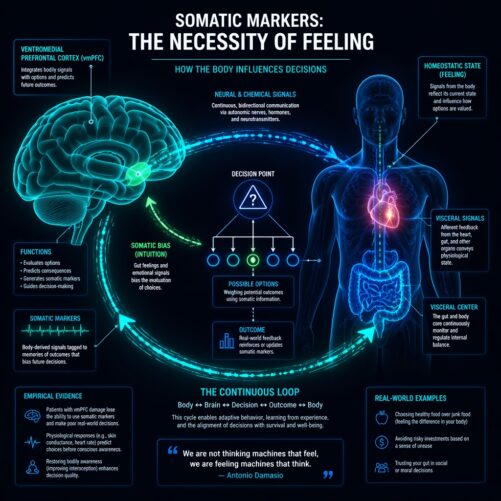
Antonio Damasio dismantled the “Cartesian” fallacy that reason and emotion are separate. His research proves that without emotional input, we are actually incapable of making rational decisions.
Damasio discovered that the brain uses somatic markers – physical “gut feelings” or sensations formed by past experiences – to tag certain options as “good” or “bad.” These markers bias our decision-making, allowing us to evaluate complex situations quickly without performing an exhaustive logical analysis of every possible outcome.
Homeostasis as a Driver
Rationality did not evolve to escape our biology; it evolved to serve it. The brain’s primary job is to monitor and regulate the body’s state (homeostasis). Reason is the tool the brain uses to navigate the world to keep the body alive and functioning. When the connection between the “emotional” circuitry (ventromedial prefrontal cortex) and the “rational” circuitry is severed, intelligence often remains intact, but the ability to make healthy social and personal decisions vanishes.
Actionable Strategy: Trust Your “Gut” as Data
- Treat Intuition as Input: When making a decision, don’t just weigh the pros and cons. Ask yourself: “How does this option feel in my body?” A sense of tension or ease is a signal from your biological architecture.
- Contextualize the Feeling: Remember that somatic markers are based on past experience. If you feel a “gut instinct” against something new, ask yourself: “Is this actual danger, or is this just my brain preferring the comfort of the status quo?”
Return to Hub: The Architecture of Human Behaviour