
Why “Rational Choice” Is a Myth
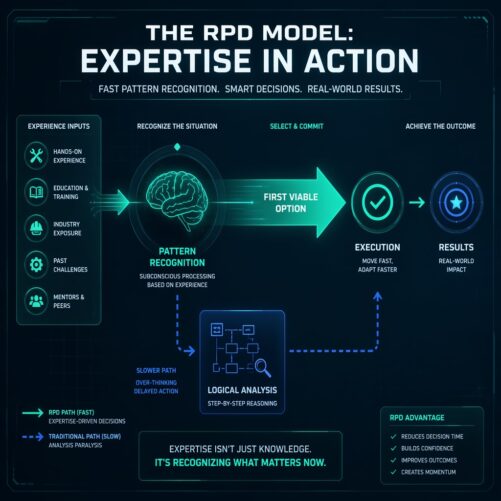
We are taught that to make a “good” decision, we must act like a computer: weigh every variable, list the pros and cons, and choose the option with the highest expected value. This is the “Rational Choice” model.
Cognitive psychologist Gary Klein’s research in Sources of Power reveals that in real-world, high-pressure environments, experts don’t do this at all. If a firefighter or a surgeon actually stopped to weigh every option, the results would be catastrophic. Instead, they use the Recognition-Primed Decision (RPD) Model.
The Core Science: Pattern Matching vs. Analysis
Klein discovered that expertise is not about having a faster computer in your head; it is about having a larger library of patterns.
When experts face a situation, they do not scan for “all possible options.” They scan for familiarity. Their subconscious mind recognizes the pattern from past experience, and they immediately identify the “first good option.”
The RPD Decision Loop
The decision-making process for an expert follows this distinct three-step loop:
- Experience: The brain recognizes the current situation as a pattern learned from past experience (often unconsciously).
- Mental Simulation: The brain “runs” a quick mental movie of what will happen if a specific action is taken. It looks for potential “deal-breakers.”
- Execution: If the simulation reveals no major flaws, the expert acts immediately.
Why “Analysis Paralysis” Happens
The reason many of us struggle with decision-making is that we are trying to force our System 2 (the logical mind) to do a job meant for System 1 (the pattern-recognition engine).
When we face a complex choice, we try to manually calculate variables that our subconscious could evaluate in milliseconds if we had the right “experience library.”
We get stuck in “Analysis Paralysis” – a state where the conscious mind gets overwhelmed by data that it was never designed to process.
The takeaway: You don’t need to “think” harder; you need to build better patterns. Behavioral mastery is simply the act of exposing your subconscious to enough high-quality data that your “first good option” becomes consistently accurate.
Applying the Science: Training Your Intuition
You cannot hack your way into instant expertise, but you can build a library of patterns to improve your “first option” generation.
- The “Pre-Mortem” Simulation: Since the brain is a simulator, use it intentionally. Before you start a project, ask: “If this project failed six months from now, why did it fail?” By forcing your brain to simulate the failure, you are building the “pattern” for what to avoid in the future.
- Force Exposure: You cannot recognize patterns you haven’t seen. If you want to get better at decision-making in a specific area (investing, coding, management), you must increase the frequency of your “data intake.” Read more, watch more, and most importantly – do more.
- Lower the Stakes to Increase Patterns: If you are afraid to make a decision because the “stakes” are high, break the problem into smaller, lower-stakes experiments. Each one gives you a new pattern to store in your mental library.
Return to Hub: The Architecture of Human Behaviour