
Why You Are a Passenger in Your Own Mind
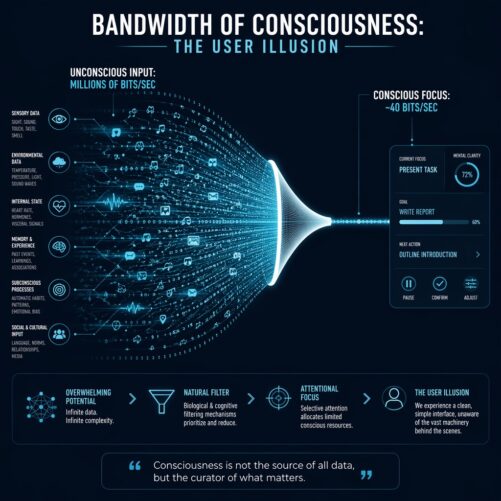
We often assume that because we are “aware” of our thoughts, we are in control of them. We believe the conscious mind is the CPU – the central processing unit running the operating system of our lives.
Tor Nørretranders’ research in The User Illusion completely upends this. He demonstrates that the conscious mind is not the processor at all. It is a highly limited user interface, a dashboard that provides a simplified view of the massive data processing happening in the subconscious below.
The Core Science: The Bandwidth Bottleneck
Every second, our senses dump millions of bits of information into our brains. Our subconscious processes almost all of it. However, the conscious mind has an incredibly low “bandwidth” – it can only process roughly 15–50 bits per second.
Exformation: The “Discarded” Reality
To make sense of the world, the brain performs a process Nørretranders calls “Exformation.” This is the massive amount of information that is processed by the subconscious and then discarded to create a manageable experience for the conscious mind.
When you look at a tree, you don’t consciously process the shape of every leaf, the exact shade of green, and the movement of the wind – your subconscious does that. Your conscious mind simply receives the “icon” labeled: “Tree.”
The “User Interface” Metaphor
Think of your brain like a computer. Your subconscious is the hardware and the complex code running in the background. Your conscious mind is the icon on your screen. * You don’t need to understand how the processor or the motherboard works to click the “File” icon.
- Similarly, you don’t need to understand the millions of neural calculations occurring to “decide” to reach for a cup of coffee.
The Trap: We often mistake the icon for the machine. We think the “conscious decision” is the engine, when it is actually just the user interface.
The Delay of Consciousness
Scientific evidence (most famously from the Benjamin Libet experiments) suggests that our brain initiates actions before we are consciously aware of them. We experience a “feeling of will” that arrives shortly after the subconscious has already started the process.
This means that “conscious will” is often a post-hoc justification – a feeling that occurs after the action has begun.
Applying the Science: Stop “Trying” and Start “Installing”
If the conscious mind is just an interface, you cannot “force” it to be more productive or disciplined. You cannot increase the bandwidth of your consciousness. Instead, you must change the subconscious inputs.
- Stop “Willpower” Overdrive: If you are failing to reach a goal, stop trying to “think” your way to success. Your conscious mind (the interface) cannot override the subconscious (the processor) through sheer force.
- Focus on Environment Design: Since the subconscious is a pattern-matching engine, design an environment that makes “good” behaviors easy and “bad” behaviors hard. By changing your environment, you change the raw data your subconscious receives.
- Prioritize “Exformation” Reduction: Clear your environment of “noise” (distractions, clutter, useless information). Since your conscious mind has such limited bandwidth, stop overloading it with irrelevant data so it can focus on the few bits that actually matter.
Return to Hub: The Architecture of Human Behaviour