
Why You Are a Stranger to Yourself
We have a deeply held belief that we are the masters of our own minds – that if we just sit down, reflect, and “look deep inside,” we can accurately identify the reasons why we feel, choose, and act the way we do.
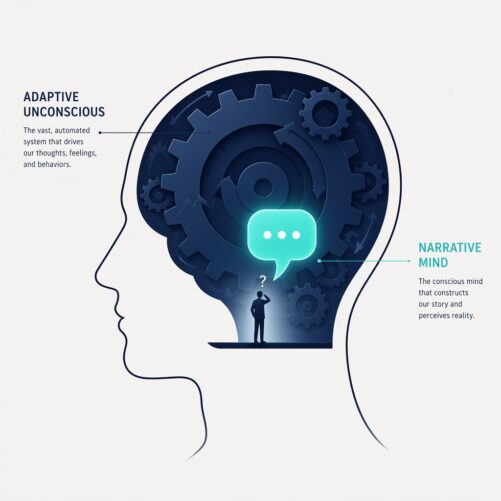
Psychologist Timothy D. Wilson’s research in Strangers to Ourselves shatters this belief. He demonstrates that our conscious mind is not the driver of our behavior; it is merely a narrator that creates stories after the fact to explain what we’ve already done.
The Core Science: The Adaptive Unconscious vs. The Narrator
Most of our mental processing occurs in the “Adaptive Unconscious” – a sophisticated, high-speed system designed to help us navigate the world without getting bogged down in slow, conscious thought.
The conflict arises because the conscious mind has no access to the vast amounts of data processing happening in the adaptive unconscious. When we ask ourselves “Why did I do that?”, the conscious mind cannot access the actual source code. Instead, it constructs a plausible-sounding story based on cultural scripts, social expectations, and logical inferences.
The Introspection Illusion
This is a cognitive bias where we believe we have privileged, accurate access to our own motives. In reality, studies show that we are often better at predicting the behavior of other people than we are at predicting our own. We look for explanations that “make sense,” not the actual, messy, biological causes.
The Subconscious Link: Post-Hoc Rationalization
Your conscious mind is constantly busy rationalizing behavior it didn’t choose.
- The “Cover Story”: When you are caught in a bad mood or make a impulsive decision, your mind immediately searches for a reason: “I’m grumpy because I didn’t have my coffee” or “I bought that because it was on sale.” * The Reality: The real cause might be a subconscious reaction to a minor social slight or a subtle environmental cue that you never consciously processed.
Because we believe these “cover stories” are the truth, we often try to fix our problems by analyzing them incorrectly. We try to change our “why,” but the “why” is just a story we told ourselves.
Applying the Science: Stop Asking “Why?”
If introspection is unreliable, how do we gain self-knowledge? The secret is to stop treating your thoughts as evidence and start treating your observed patterns as data.
- Shift from “Why” to “What”: Stop asking “Why am I procrastinating?” (This leads to fabricated stories). Start asking “What happened right before I started procrastinating?” and “What do I do when I am most productive?” Focus on the external triggers and your behavioral outputs.
- Use Third-Party Observation: Since you are better at predicting others’ behavior than your own, treat yourself like a subject in an experiment. Keep a “behavioral log” for a week. Note your mood, your environment, and your actions. Look for patterns in the data, not your justifications.
- Accept the “Narrator” as Flawed: The next time you find yourself explaining your motives, pause and ask: “Is this the truth, or is this just a story that makes me feel better?” Developing this level of humility is the hallmark of true self-awareness.
Return to Hub: The Architecture of Human Behaviour