
The Core Science: The Low Road vs. The High Road
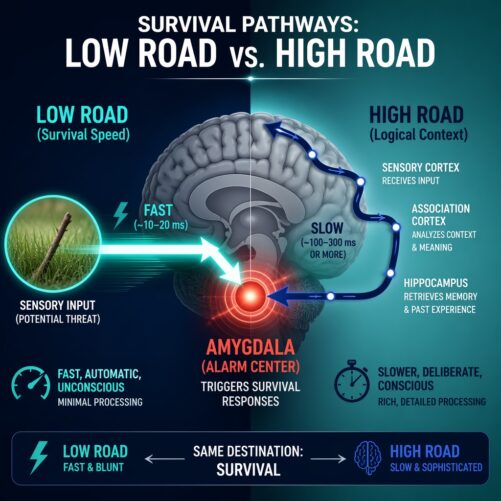
Joseph LeDoux’s research revolutionized our understanding of the “emotional brain” by mapping how the amygdala processes threats. He identified two distinct neural pathways that dictate how we respond to stimuli:
The Low Road: Sensory information travels directly from the thalamus to the amygdala. This path is lightning-fast and bypasses the conscious, thinking brain entirely.
It is designed for survival – it triggers a “fight-or-flight” response before you consciously know what you are looking at.
The High Road: A slower, more precise pathway that travels from the thalamus to the sensory cortex, and then to the amygdala.
This route allows the conscious mind to analyze the context (e.g., realizing the “snake” in the grass is actually a garden hose) and override the initial emotional reaction.
Emotional Memory
LeDoux distinguishes between “conscious memory” (explicit facts) and “emotional memory” (implicit, fear-based conditioning). You can have an intense physiological response to a stimulus without being able to consciously recall why you are feeling it. This is why we often feel “hijacked” by our emotions before our logic has a chance to catch up.
Actionable Strategy: The “Cool-Down” Pause
When you feel a sudden surge of anger or anxiety, recognize that your “Low Road” is in the driver’s seat.
The 10-Second Delay: Consciously force a short delay before acting or speaking. This creates the necessary time for the “High Road” (the neocortex) to process the information and provide a more accurate, logical assessment.
Return to Hub: The Architecture of Human Behaviour